
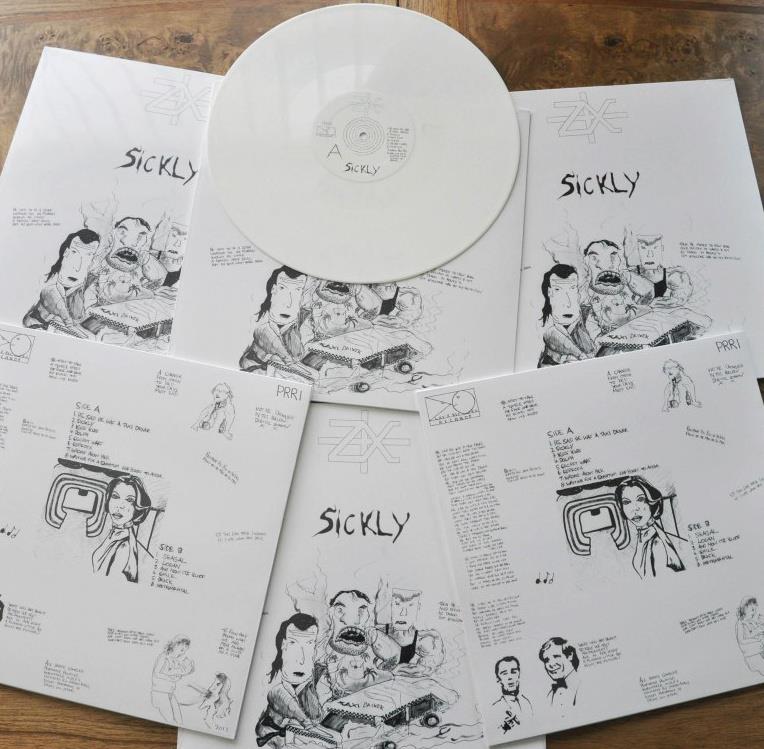
ZX+ is the brainchild of Twisted Wheel’s bass player Stephen Evans, which showcases his diverse virtuoso guitar playing, skillfull songwriting and pristine, youthful vocals. As an album of 14 tracks, “Sickly” really delivers the goods proving that Evans isn’t a one-trick pony and has his finger on the pulse when it comes to fresh, contemporary rock music. Think of a laidback Beatles, an understated Led Zepplin and a rudimentary Pink Floyd fused together and plugged into a space-rock amp, then you get the kind of idea what ZX+ is all about. Somehow, Evans launches ZX+ towards an idiosyncratic space-rock arena, but without the pretentiousness or grandiose of Muse and co. Instead, ZX+ is a more refined, measured production, a one-man band whose subtle zany riffs and digital inserts hallmarks an original and intricate album. What’s great about this album is Evans’ endless talent at experimental strumming whilst maintaining a breezy set of pipes. As a singer Evans really comes into his own, effortlessly narrating with a jaunty and wry delivery, whilst rebooting through the electrocardiographic machine of riffs.
Kick-starting with “He Said He Was A Taxi Driver”, you instantly become connected with Evans’ zany innovation, sheer talent and galactic guitars. Like a space-surfer, “He Said He Was A Taxi Driver” scrapes and antagonises against Evans’ charged up vocals, allowing the adrenaline to leak through the lively beats. It’s a force of nature, a concentrated snippet, giving us a glimpse of brilliance through its telescopic tones.
Sounding like The Beatles and Bjork’s love-child, “Sickly”, sees Evans vocals narcotized against the subtle psychedelic drones and lethargic, circular riffs. It’s also a song which is characterized by the staggered and dragging digital beats, that pulls the song towards a drum and bass horizon. Along with “Sickly”s undercarriage of reflective acoustic riffs, it’s through the lyrics such as “He lives on a hill on his own, he doesn’t like living alone...” that you hear a stripped down simplicity likened to The Beatles, “The Fool on The Hill”, reinforcing the psychedelic folk veneer.
At just 32 seconds long “Kiss Kiss” jump-leads the album from any lingering lethargy, unleashing an array of post-punk riffs that wriggle and slam against the flush of angst-ridden vocals. It’s a great little upsurge of energy which effortlessly blends into the next track, “Dolph”.
Paying homage to actor Dolph Lundgren, “Dolph” illustrates Evans’ off beat and eclectic songwriting skills. As a track, “Dolph” bobs and kicks like a Russian folk dance, before it is hijacked by celtic rock riffs, reminiscent of Thin Lizzy, that curve and preen against the fleeting Black-Key-esque riffs and militant beats.
With it its wah flashes, muffled and animated dual vocals, “Secret Wars” sees Evans embrace a more psychedelic folk sound, a trippy aftermath that captures the essence of the song, giving a feeling of solar-flares, euphoria against the slamming acoustic strums. It’s also a song, whose out-tro of digital beeps consolidate with the sci-fi infused lyrics and whose drawn out vocals, dip and elate creating a dramatic soundscape.
“Rebecca” is a jittery, off beat track, whose galloping riffs side-saddle against the wry lyrics. It’s a great track, which sees Evans adopt a more cynical and humorous delivery. Along with the riffs, “Rebecca” slams and races, creating a mayhem of fast interchanging riffs.
“Wrong about her” reverberates and curves with melancholy against the sombre vocals. Along with the blackened lyrics, “Wrong about her”, emits a sentimental sadness that echoes through the backdrop of white noise and subtle industrial clanks.
“Waiting for a Quantum Leap” jumps in with an impetuous energy which is characterised by the stream of 70s riffs, that zig-zag and run undercover against the racing and plucky acoustic riffs. It’s a great track, which once again illustrates Evans’ skill at penning an original lyric. Lyrics such as: “What will Sam Beckett, do about his next predicament? Ask Al, ask Ziggy, a flashing little box from the future…”, shrink-wraps the notion of the song, whilst projecting a sense of intrigue.
Again, what appears to be paying homage to one of his favourite actors, “Seagal” sees Evans unleash an array of dipping, jumpy and crunchy riffs that are hijacked by a wave of 7os riffs and crashing beats. It’s also through Evans’ irregular vocals that “Seagal” is singed with an erratic edge which is regulated during the rolling and chugging out-tro. Along with the glossed over, Queen-esque, dual backing vocals, “Seagal” surfs the proverbial 70s tide, whilst being injected with a bit of modern day originality.
Likewise, “Logans Run” is an individual and original track, which sees Evans really come into his element, showing us what a talented all-round musician he is. Possibly the best song on the whole of the album, “Logans Run”, jangles and ponders with a poignant sentimentalism that is filtered through the clunky and reverberating riffs. The track resonates and ingenuously emits a range of emotions. Through its sitar-esque strumming and wah splodges, “Logans Run” stays true to its psychedelic roots, whilst mutating into a series of more powerful and emotionally fuelled riffs, which sound in parts like they are talking to you! It’s like they are in 3D, projecting an abstract motif, which delves deep and communicates the morphing emotions of the song. Along with the backdrop of swaying backing vocals, “Logans Run” transcends a dreamy surrealism that is reminiscent of hazy 60s psychedelic folk. Lyrically, “Logans Run” is steeped with cerebral depth, throwing lines such as “…Only you can stop machines, controlling how we think and when to die, so Logan 5..”, whilst casting an understated darkness.
With its staccato, clanging riffs, militant beats and bouncy bass “And Now it’s Blood” chops and slams with a snappy energy that synchronises with the thematically reckless lyrics. It’s a multi-textured song, which sees Evans indulge in an assault of abrasive riffs that fuse together to create a metallic mash of sounds. Along with singular curving and scrapey, reverberating riffs, “And Now it’s Blood” denotes a wayward chaos that is deeply embedded in its musical fabric that antagonises and grinds against Evans’ soft tones.
“Smile” is the most subdued infused tracks on the album whose sombre vocals and melancholic backing vocals create an almost theatre ambience you would half expect from a couple of street entertainers. It’s a quirky song, whose upsurge of disjointed vocals, springy inserts and lethargic strumming drags the dark lyrics into the forefront, whilst projecting a jittery and nervous disposition.
“Brick” is a fast mover, whose racing riffs gallop and leap like a cowboy on heat against the slithering and glam rock riffs. It’s a catchy song which sees Evans’ skill at presenting an array of nimble-fingered riffs whilst drawing you in with his changeable vocal tones.
From the opening riffs which quietly reflect to the backtracking psychedelica, “Instrumental” emerges like a sunrise awakening from dawn, whose more up-tempo riffs closes “Sickly” with a euphoric high, casting its trippy, space-rock in one final take.
‘Sickly’ will be released on May 15th 2013, via Stephen Evans’ own label “Play and Record Records”, on a rare white vinyl, which you can pre-order now. With just 250 limited copies, it’s definitely worth a purchase.
http://youtu.be/fu3baDlZJz8